You’ll Be Able To See This Sculpture As It Orbits Earth
The artist Trevor Paglen will launch a long, reflective satellite into space next year, a project 10 years in the making.
There are several thousand satellites orbiting the Earth at any given moment. From GPS satellites and television satellites to communications satellites and defense satellites, all of them are in space for a military or commercial reason. The artist Trevor Paglen, however, is launching a new type of satellite: a giant sculpture that will orbit the Earth purely as art.
The space sculpture, called Orbital Reflector, is a 100-foot-long diamond-shaped balloon that will zoom around the planet, reflecting the sun off its silver surface. Anyone on Earth will be able to look into the night sky and see it slowly making its way through the cosmos like a man-made comet. It will even be visible from cities–Paglen says the satellite will be as bright as the stars of the Big Dipper.
“It’s trying to do aerospace engineering for aerospace engineering’s sake, to make it this aesthetic practice or goal,” Paglen says. “Can you build a satellite that’s actually the exact opposite of every other satellite that’s ever been made?”
Ten years after Paglen first conceived of the idea for the sculpture, Orbital Reflectorwill launch in early 2018 as a secondary payload–meaning it’s not the primary satellite being launched–on the SpaceX Falcon 9 rocket. To bring the project to fruition, Paglen is collaborating with the Nevada Museum of Art, which currently hosts a spherical prototype of the sculpture. They are now raising money on Kickstarter to contribute at least $70,000 of the total $1.3 million cost. While that’s nothing compared to the $50 million to $100 million price tag of most satellite launches or the millions spent on large museum installations, it’s still a hefty amount of money to spend on a space balloon that will crash back into the atmosphere and burn up within two months.
To design the sculpture, Paglen teamed up with Zia Oboodiyat–a space industry veteran who has shepherded a dozen satellites into orbit, including those for countries like India and Japan. Oboodiyat also helped Paglen with his 2012 project The Last Pictures, in which he launched a disk containing 100 photographs that tell the story of human history onto a satellite headed for deep space. To make Orbital Reflector viable, Paglen and Oboodiyat designed an inflatable satellite that folds up into a small rectangular box, which can piggyback on a rocket carrying a significantly larger satellite.
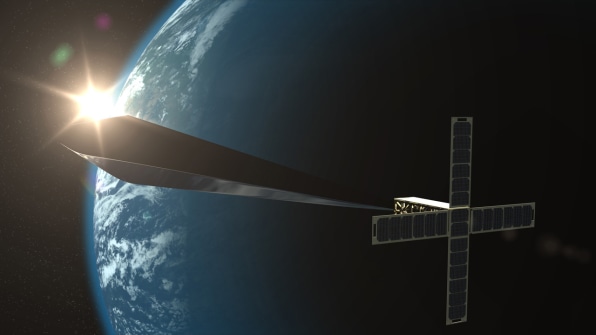
Design concept rendering for Trevor Paglen: Orbital Reflector, coproduced and presented by the Nevada Museum of Art. [Image: courtesy Nevada Museum of Art]
Oboodiyat says the process of designing the satellite relies on basic orbital mechanics: You can’t send it too far into orbit, otherwise you won’t be able to see it from Earth, but you also can’t keep it too close to the planet, otherwise gravitational forces and drag will pull it too close to the atmosphere, where it will burn up. They’ve aimed for a middle ground, where the balloon should stay aloft for one to two months, barring any problems with deployment.
For those months that the sculpture is aloft, an app will tell you when it’s passing overhead–which should be two or three times a day. Paglen plans to organize sculpture-gazing parties at art museums around the country.
“It’s equal opportunity to all human beings on Earth,” says Oboodiyat of the chance to see an art piece in space. “It’s really a good message for humanity.”

Prototype for Trevor Paglen: Orbital Reflector, coproduced and presented by the Nevada Museum of Art, on view in the Donald W. Reynolds Grand Hall at the Nevada Museum of Art. [Image: courtesy Nevada Museum of Art]
While Paglen has had a longtime fixation with space, he’s well known for his work critiquing surveillance and the military–a thread that runs through Orbital Reflector, too. All U.S. satellites were classified as munitions and regulated by the Pentagonuntil 2012. “The other part of the project is really thinking about the actually existing history of spaceflight, which is very much the history of nuclear war,” he says. “Satellites were developed as a byproduct of ICBMs and the first satellites were demonstrations that you could send a nuclear warhead across the planet. What would space look like if it were demilitarized? I’m not sure it would exist.”
Yet Orbital Reflector is primarily meant as a mechanism for wonder, a continuation of the long tradition in human history of looking wide-eyed to the unknown of the universe. “Historically, people have always looked to the stars to try to find answers to big questions–who are we, where are we going, where do we come from,” Paglen says. “That was true of the Greeks, that was true of the Babylonians, trying to figure out the future from looking at the stars. It’s true now with the Hubble Space Telescope, trying to see the edges of the universe.”
With thousands of military and commercial satellites cluttering up low Earth orbit, it’s about time one of them was beautiful.
Comments